Before the RFP Defines the System
Many of the most important decisions are made before the document is drafted.

By the time an RFP is issued, many of the most important decisions have already been made. Some are visible. Others are embedded in the way the document defines the problem, separates workflows, assigns coordination, describes reporting, or assumes how partners will exchange information. The procurement may look like the start of a technology decision. In complex crisis environments, it often formalizes a governance direction that has already started to take shape.
The Continuum Behind the Document
No crisis service environment was built as a single system. Crisis lines, mobile response, stabilization, follow-up, and peer support programs each started separately, shaped by the funding and policy of the moment. Coordination came later, expected of services that were already running. That history often follows the system into procurement, where individually sound decisions can still leave the broader continuum without a shared operating model.
We run into this pattern in our own work. A document arrives focused on one program, 988, mobile dispatch, or stabilization, and we respond to what’s there. Then alignment begins and the picture widens. Other programs have to be brought in. Data flows that looked clean in the original scope need reworking. The governance questions have usually moved by the time we get there.
Some procurements have started to reflect the continuum more accurately, with RFPs that cover multiple workflows and allow multi-vendor responses. That is closer to how crisis systems actually operate, but it also raises a governance question the single-program procurement rarely had to answer: where should coordination sit? When that role is assigned to one vendor, the procurement may solve for coordination administratively while placing cross-continuum authority inside a contractor relationship.
Where that role sits should be decided deliberately, before the procurement defines it by default.
Coordination across a crisis continuum is governance work; it determines how partners align, how information moves, how decisions are made, and how accountability is sustained. Where that role sits should be decided deliberately, before the procurement defines it by default.
Interact Strategies responds to RFPs, supports public-sector technology decisions, and understands the role procurement plays in fairness, structure, and accountability. Procurement is most effective when it’s guided by a clear understanding of how the environment is meant to operate, and that clarity is built upstream.
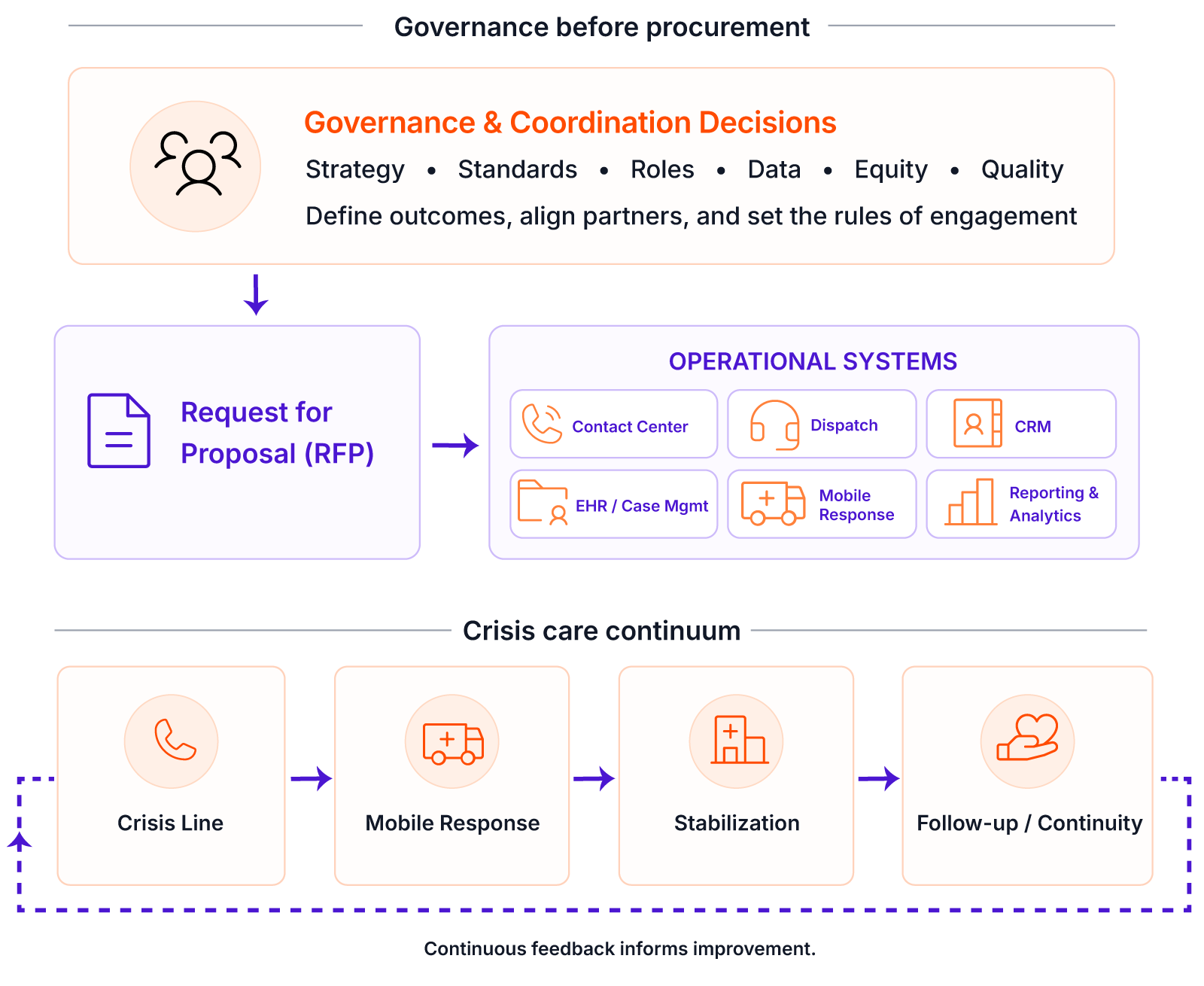
Governance and coordination decisions sit above procurement, shaping what the RFP can deliver and how the continuum holds together.
Upstream of the Document
We recently provided recommendations to an agency responsible for a statewide crisis continuum as it worked through exactly this kind of upstream question. A network of independent providers is already operating, and the next phase of technology investment remains an open question: a single vendor, a modular setup, or a hybrid. Before that path can be settled, there is a more basic question: what does coordination across the continuum need to accomplish?
The work starts from a few premises. Getting visibility across the continuum does not mean replacing the systems providers already rely on. Continuity has to hold across the whole crisis journey, from the first contact through mobile response, stabilization, referral, and follow-up, even when different organizations handle different parts. The model keeps providers on their own workflows, with standardized data moving under clear rules for access and privacy. New capabilities arrive one phase at a time, each tied to what the law allows, what providers are ready for, and what can actually be measured. Within that framing, three governance decisions in particular determine what the procurement can later carry.
- Authority. A continuum of partners operating under separate mandates does not answer to a single chain of command, and authority shifts with the decision at hand and with the partner it most directly affects.
- Information. How data moves between partners is a governance question well before it’s a technical one. What gets shared, and with whom, comes down to regulation, to what each partner is willing to put on the table, and to trust built up over years. That gets worked out between people, not in a system spec. The technology holds up best when it follows decisions the organization has already made about what moves where, and on what terms.
- Timing. Not every partner is ready to absorb changes on the same schedule. Readiness depends on funding cycles, on capacity, and on whether a partner can take on something new without putting what it already does at risk.
When the Solution Arrives Before the System Is Understood
The early work on any system is meant to reveal how an environment actually operates before anyone commits to a design. But reality can be different.
Discovery frequently arrives carrying strong references from other health systems, models proven somewhere that resembles this one on paper. Those references are genuinely useful, and they can also foreclose the questions too early, steering toward a familiar architecture before anyone has mapped what this particular continuum requires. That is the risk, because a model that succeeded elsewhere may not hold here.
Discovery that engages those differences first, before it reaches for the technology questions, produces a system shaped to the environment it actually serves.
Partners are organized differently, funded differently, and responsible for different parts of the work, and what continuity demands across services shifts with every environment. Discovery that engages those differences first, before it reaches for the technology questions, produces a system shaped to the environment it actually serves. When discovery skips that step, the gap tends to surface six to 12 months in. The architecture meets a continuum it was not built for. Routing that looked sound on paper needs reworking. The integrations hold up technically, but the way partners coordinate day to day does not match what the system assumed. Some adjustment after go-live is normal, but when the underlying governance questions were not clarified early, that adjustment becomes part of running the system.
Whether an internal team or an outside partner runs this early work matters less than it seems. What counts is the clarity the work produces before procurement begins: a clear view of what the continuum is trying to accomplish, how its workflows and information move across it, and where authority and accountability ultimately rest.
The Baseline That Becomes the Standard
Most procurements produce systems that work. Transitions complete, services continue, and by any reasonable measure the outcome is acceptable.
The question worth asking is what we are measuring acceptable against. When most leaders inherit a fragmented architecture, the cost of that fragmentation gets absorbed into the daily work of running the environment, until it no longer looks like a cost at all. Integration work that should seem excessive starts to feel routine. Coordination gaps that should prompt questions start to feel like the way things are. The baseline becomes the standard, and each new procurement rebuilds the same architecture.
None of this is an argument against procurement. It is a necessary instrument for any organization acquiring a complex system, and a well-designed RFP carries real weight for the work it is built to do. What is worth holding open is whether the document is being asked to carry work that belongs in a different conversation. When the governance conversation has already happened, the procurement that follows is shaped by the clarity that work produced.
That kind of clarity is hard to reach from a distance. A lot of discovery, by necessity, happens through stakeholder interviews and document review, which gives a real but partial picture. The same gap can look one way in a process diagram and very different from a chair next to the people doing the work: taking calls, coordinating mobile response, managing referrals, or closing the loop after a crisis contact. The situations that actually shape that work usually come up in conversation with the people doing it, and that kind of access is not always part of how discovery gets scoped.
Interact Strategies starts where the interaction happens, giving us a practical view of how the crisis continuum operates across services, partners, workflows, and responsibilities. Even when that context is not fully visible in a procurement document, we know how to surface it.
We work alongside leadership teams to clarify what needs to be settled upstream: who owns continuity, how information moves, where authority sits, and how accountability is sustained after implementation.