What Crisis System Change Reveals About the System Behind the Interaction
The decisions that shape long-term stability in crisis service environments are often made well before implementation begins.
Crisis service environments change for many reasons. Contracts end. Platforms reach functional limits. Organizations consolidate, grow, or restructure how services are delivered.
In most cases, the technology performs as expected. What becomes difficult to see, and far more consequential, is the governance environment surrounding the system. Risk in crisis service transitions tends to originate not in the platform but in the structures around it: undocumented decisions, informal workarounds, escalation practices shaped by habit, and ownership assumptions that were never formalized. These patterns exist in nearly every mature operating environment and rarely surface under stable conditions. During a transition, each one becomes a likely point of strain.
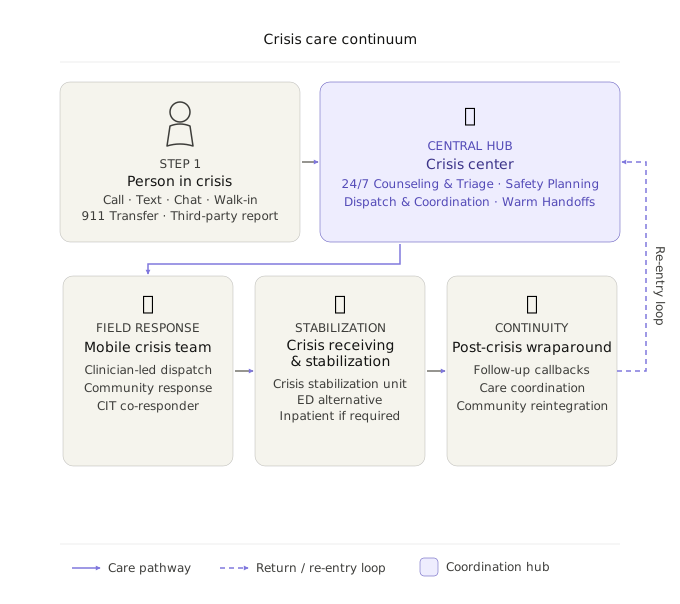
Crisis centers are often where that strain becomes visible first. As the front door to the broader crisis care continuum, the crisis center is where demand, urgency, and operational pressure surface in real time, and where the quality of upstream decisions is felt most immediately.
What Change Tests First
- Whether decision authority is clear
- Whether ownership holds across partners
- Whether workflows remain coordinated under strain
- Whether continuity can be protected beyond the initial interaction
When governance is strong, the crisis center functions as the entry point into a coordinated, reliable system. When governance is weak, the crisis center absorbs the consequences of gaps that originate elsewhere in the continuum.
Behind every crisis center interaction sits a broader service environment. Crisis lines, mobile crisis teams, stabilization services, post-crisis follow-up, peer support programs, and coordinating partners all operate within an interconnected continuum.
The strength of a crisis service environment is not determined by any single platform or workflow. It is determined by how well the system behind the interaction holds together under real operating conditions.
Where Change Exposes What Was Never Formalized
The early indicators of misalignment during a transition tend to be subtle: small shifts in how teams operate, how information flows, and how decisions are validated. Individually, none register as significant. Core metrics may still fall within acceptable ranges. Attention stays focused on whether the platform is functioning rather than on whether the governance environment surrounding is holding.
The challenge is when these small shifts compound. By the time patterns become visible across an organization, correction requires coordinated intervention at multiple levels. The decisions shaping stability are often ones that were made informally over time.
A system change brings those informal structures into sharp focus, and the ones that were never formalized become the gaps that are hardest to close. This is why governance and accountability frameworks are far easier to define before a transition rather than to establish them once strain has surfaced.
From Periodic Review to Continuous Practice
Across an environment this interconnected, governance cannot function as something leadership revisits quarterly or delegates to a single team. It must operate as a continuous practice embedded in how decisions are made and how accountability flows across teams and partners.
That means that before a system change begins, leadership should be confident that decision authority, data integrity, performance oversight, and escalation ownership are clearly established across the organization and its partners. When these structures are in place early, organizations respond to emerging strain with greater speed and consistency. When left undefined, decisions slow precisely when they need to accelerate.
This is also where governance begins to serve a broader purpose. Well-defined decision structures not only protect against risk during a transition, they create the foundation for how an organization operates across the continuum on an ongoing basis. The discipline required to govern a transition well is the same discipline required to govern complex crisis service environments over time.
Accountability That Holds Beyond Launch
Crisis service environments depend on the coordination of multiple organizations, each carrying responsibility for a different part of the continuum. Internal teams, external partners, oversight bodies, and funding stakeholders all contribute to the stability of the broader environment. When ownership of critical functions is clearly assigned at both the organizational and individual level, accountability becomes structural rather than assumed.
That accountability is tested most visibly after the initial moment of change. Leadership attention naturally concentrates on launch readiness. Yet, the deeper question is whether governance, ownership, and accountability remain durable once the environment begins operating under real conditions. Long-term continuity depends on decisions made well before the transition begins.
Sustaining that continuity also depends on how leadership treats historical data and stakeholder confidence. For leadership teams accountable to funders, legislators, and oversight bodies, data continuity is a governance consideration, not a technical one. The confidence that stakeholders, partners, and teams carry through a transition is shaped by how predictably leadership communicates throughout. Both are expressions of the same principle: that continuity is not a technical outcome, it is a leadership one.
Strengthening the System Behind the Interaction
The risk in crisis system change is not the change itself. It is whether the governed environment behind the interaction is strong enough to hold.
“Crisis system change does not only test the technology at the front door. It tests whether the broader support system behind that interaction is organized to hold together across services, partners, workflows, and responsibilities.”
A well-governed transition becomes an opportunity to strengthen the broader environment. The process of formalizing ownership, defining accountability, and establishing governance discipline across the continuum creates structures that serve the organization well beyond the transition itself. Leadership teams that approach change with this perspective build environments that are more resilient, more clearly governed, and better positioned for whatever comes next.
Related Resources
Interact Strategies starts where the interaction happens and works alongside leadership teams to strengthen the governed support system behind it, across the full continuum. That is where our work begins, and where it stays.